The Lost Venetian Monorail Resort
There are few companies on Earth better at controlling land, infrastructure, and long‑term planning than Disney.
Which makes it even more fascinating that there is a prized piece of land at Walt Disney World that Disney has tried, twice, to develop, and failed both times.
Not because of lack of imagination.
Not because of demand.
Not even because of money.
But because the land itself quietly refuses to cooperate.
Welcome to the story of Disney’s lost Venetian Monorail Resort.
A hotel that was planned in the 1970s.
Resurrected in the 1990s.
And ultimately abandoned again.
On paper, it should have been one of the most iconic resorts Disney ever built.
In reality, it became one of the most mysterious “what‑ifs” in Disney history.
The Golden Age Plan Disney Never Finished
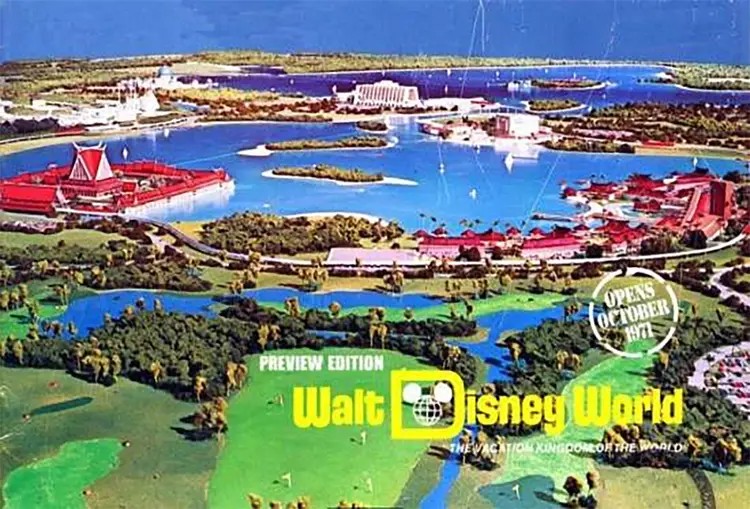
When Walt Disney World opened in October 1971, Magic Kingdom was only part of the vision.
The real master plan included a ring of luxury resorts surrounding Seven Seas Lagoon and Bay Lake, each connected by boats and the monorail system.
Among the original trio of planned deluxe hotels were:
- Disney’s Asian Resort
- Disney’s Persian Resort
- Disney’s Venetian Resort
Each was designed to sit on the monorail loop, offering direct transportation into Magic Kingdom and positioning Disney as not just a theme park, but a global destination resort.
The Venetian was arguably the most ambitious of the three.
Inside the Original Venetian Resort Vision
According to Disney’s own early announcements, the Venetian Resort would have opened on October 1, 1971, the same day as Magic Kingdom itself.
The plan included:
- Approximately 500 guest rooms
- A network of canals throughout the resort
- Gondolas transporting guests between shops and restaurants
- Italian architecture inspired by Venice and St. Mark’s Square
- A 120‑foot bell tower (campanile)
- Direct access to the Magic Kingdom monorail loop
The resort was planned to sit between the Transportation and Ticket Center and Disney’s Contemporary Resort, placing it on a premium piece of waterfront real estate along Seven Seas Lagoon.
In many ways, it would have been a European counterpart to the Polynesian and Contemporary resorts.
And then it vanished.
The First Cancellation
The 1973 Oil Crisis
The Venetian Resort was not alone in its cancellation.
By 1974, all three original unbuilt deluxe resorts were shelved as the United States entered the 1973 oil crisis, triggering an economic downturn and sharply reducing travel and tourism.
Disney made a strategic decision to pause all non‑essential expansion.
The Asian and Persian resorts would never return.
But the Venetian was different.
Disney didn’t let it go.
When Eisner Brought It Back
The Grande Venezia Era
Fast forward to the late 1980s and early 1990s.
Michael Eisner had just overseen the opening of Disney’s Grand Floridian Resort, which instantly became Disney’s flagship luxury hotel.
Buoyed by its success, Disney revisited the Venetian concept, this time under a new name:
Disney’s Grande Venezia Resort.
The updated plans were even grander.
They included:
- Expanded canals with working gondolas
- Lighted fountains across the property
- A masquerade‑themed pool
- A conference center
- A wedding chapel
- Architecture designed by the same firm behind the Grand Floridian
Once again, the site selected was the same strip of land between the Contemporary Resort and the Transportation and Ticket Center, with planned monorail access.
And once again, it died.
The Real Problem
The Land Itself
The official story often cites shifting priorities and changing tastes.
But buried in historical records is a more inconvenient truth.
The land chosen for the Venetian and later the Mediterranean Resort was discovered to be too swampy to safely support the massive foundations required for a deluxe monorail‑connected resort.
Engineers found that building on the site would require extremely deep, expensive foundations, far beyond what made financial or structural sense.
In short, Disney picked the perfect location.
And the wrong land.
Why Disney Still Hasn’t Built There
That same parcel of land has remained conspicuously empty for decades.
Even as Disney aggressively developed:
- Bay Lake Tower
- Grand Floridian extensions
- Wilderness Lodge expansions
- New Disney Vacation Club resorts
The Venetian site never resurfaced.
Instead, Disney quietly avoided it.
The land remains constrained by environmental challenges, water management considerations, and long‑standing development limitations tied to Bay Lake and Seven Seas Lagoon drainage systems.
Disney can design around many things.
Geology is not one of them.
A Resort That Technically Never Existed
But Still Shaped Disney
What makes the lost Venetian so interesting is that its DNA lives on everywhere.
You can see it in:
- The European theming of EPCOT’s World Showcase
- The Riviera Resort’s Mediterranean influence
- Disney’s later obsession with immersive resort environments
- Even the popularity of gondola‑based transportation concepts at other Disney properties
The Venetian Resort didn’t open.
But its ideas did.
The Irony of Control
Disney controls more land than many U.S. cities.
For decades, it governed itself through the Reedy Creek Improvement District, granting the company unparalleled development freedom across roughly 25,000 acres of Florida land.
And yet.
This small stretch of land next to Magic Kingdom quietly said no.
Twice.
Not through lawsuits.
Not through politics.
Not through public backlash.
But through physics.
The Resort That Will Never Be Built
Could Disney ever try again?
Technically, yes.
Realistically, no.
The economics no longer justify the risk.
The engineering hurdles remain prohibitive.
And modern Disney prefers scalable, modular resort development over single mega‑projects tied to fragile land.
The Venetian Monorail Resort lives on as concept art, postcards, blueprints, and speculation.
A reminder that even Disney can’t out‑imagine nature.
Final Thought
Every Disney fan knows about rides that never opened.
Very few talk about resorts that almost defined an era.
The Venetian Monorail Resort is one of the great lost chapters of Walt Disney World.
A spectacular idea.
A perfect location.
And land that simply would not cooperate.
Sometimes the most interesting stories are the ones that never happened.
When Disney Built Homes Instead of a Resort
While Disney never built the Venetian Monorail Resort planned for this land, the company did ultimately allow one form of residential development inside Walt Disney World. Golden Oak is Disney’s private, luxury residential community, located within the resort but intentionally set outside Disney’s operating cities. These homes sit in unincorporated Orange County on Disney‑owned land, offering residents the rare opportunity to live inside Walt Disney World while remaining separate from the theme park, hotel, and municipal infrastructure that surrounds them.
Today, that legacy lives on not as a resort, but as one of the most exclusive residential communities in the world.
Homes for Sale in Disney Golden Oak
[optima_express_toppicks id=”2990605″ resultsPerPage=”100″ header=”true” showSearchForm=”false” includeMap=”false” status=”active”]